Garbage In, Garbage Out: How to Produce AI Content Worth Citing
The model is a commodity. For a digital asset company, the gap between content that builds authority and AI slop is the system around the model: a living context layer, your own expertise, real buyer intelligence, and a human editor in the loop.

In 2025, 53.7% of long-form posts on LinkedIn were likely AI-generated, according to an Originality.AI study of posts published between January and November. The flood is measurable, and most of it is interchangeable. Meanwhile the answer engines buyers now consult first, ChatGPT, Claude, and Perplexity, are trained to skip text that reads like everything else. A separate Yext analysis of 6.8 million AI citations found that 44% point to first-party websites, and 86% to sources brands already control. The conclusion is uncomfortable for anyone publishing generic AI output: it does not just underperform, it is invisible.
Producing content with AI that buyers and answer engines actually cite is an input problem, not a model problem. Everyone runs the same models, so the model cannot be the edge. The edge is everything assembled around it: a living context layer, the company's own unpublished expertise as source material, intelligence on what the buyer actually needs, a production pipeline of specialized agents, and a human editor in the loop on every piece.
Key takeaways
- 53.7% of long LinkedIn posts in 2025 were likely AI-generated. Generic output is now the default, which is exactly why it no longer works.
- The model is a commodity. Claude, GPT, and Gemini are available to everyone, so output quality is decided by input quality, not model choice.
- A blank prompt returns the statistical average of everything written on a topic. That average is slop by definition, and it reads like a press release nobody requested.
- AI engines cite first-party, structured, specific content. Yext put first-party sites at 44% of 6.8 million citations, and sources brands control at 86%.
- The anti-slop system is five parts: a living context layer, the firm's own expertise, intelligence on the buyer universe, a pipeline of specialized agents, and a human editor in the loop. Performance data feeds back into the context layer, so the engine improves with every piece it ships.
Why is most AI content slop?
Most AI content is slop because of the input, not the model. Handed a blank prompt and an instruction like "write a thought leadership post about stablecoins," a model returns the statistical average of everything ever written on stablecoins. That average is generic by construction. It reads like everyone because it was assembled from everyone.
The models themselves are no longer a differentiator. Claude, GPT, and Gemini are one subscription away for any team, which means the competitive question moved from "which model" to "what you feed it." Originality.AI's 2025 sample, drawn from 99 influential LinkedIn voices across tech, finance, and other sectors, found more than half of long posts were likely machine-written. When the majority of a feed is produced the same way, sameness is the signal a reader and an algorithm both learn to filter.
For a digital asset company, the cost is sharper than a low engagement rate. The buyers here are technical and the market is relationship-driven. A custody buyer, a protocol's risk lead, or a treasury allocator reads one generic paragraph about "the evolving digital asset landscape" and concludes the author has nothing specific to say. Generic content does not build authority in this market. It spends it.
What are the four ways AI content goes wrong?
AI content fails in four specific ways, and each one is an input failure that compounds the next. Teams blame the model when the real problem is a blank starting point, no source material, a single overloaded prompt, and no fact-check or human editorial layer. Fix the four and the same model produces work worth publishing.
The first failure is the blank prompt: a model given no context fills the vacuum with averages. Second, inventing from nothing. The best raw material a company has is usually already written down, in documentation, research, sales calls, and the founder's own arguments, and skipping it forces the model to fabricate filler. Third, the single mega-prompt, asking one instruction to research, draft, fact-check, format, and self-edit at once: five distinct jobs pretending to be one. And the fourth is shipping without a fact-check or an editor, so invented numbers and machine-pattern phrasing reach the reader intact.
| Failure mode | What it produces | The fix |
|---|---|---|
| Blank prompt | The average of the internet, zero specificity | A context layer the model writes against |
| Inventing from nothing | Fabricated filler, no real insight | Source material from the company's own expertise |
| One mega-prompt | Shallow output, no fact-check, AI tells intact | A pipeline of specialized agents |
| No editorial layer | Invented numbers, machine-pattern prose | Fact-check against source plus a human editorial pass |
The implication for a commercial team is that better prompting is not the answer most vendors sell it as. A prompt is the last and smallest input. The work that decides quality happens before it, and a team that fixes only the prompt is optimizing the one step that matters least.
What is a content context layer?
A context layer is a set of reference artifacts the model writes against, built before any drafting begins. The foundational ones: the product stack, the firm's positioning, a voice and writing guide, the buyer cohorts the content targets, and a map of the actual questions those buyers type into AI engines. Every brief and every draft runs against these artifacts. No artifacts, no content.
Those five are a floor, not a ceiling. A competitive landscape, an objection map built from lost deals, a proof-point library, a regulatory posture summary: each additional artifact hands the model specificity it cannot infer from a prompt. The working rule is that more context beats less, with one filter: every artifact has to be relevant to what actually gets written. An artifact no draft ever draws on is maintenance weight, not context.
The layer is also alive, not a one-time setup. It updates when the product ships something new, when positioning sharpens, when a buyer cohort changes shape. And it updates on results: which pieces earned replies, which got cited by answer engines, which held attention and which died feed back into the artifacts, so the next brief starts smarter than the last. That loop is what turns a content process into a self-improving production engine. A static context layer produces month-one quality forever. A living one makes month twelve write better than month one.
How do you build content from expertise you already own?
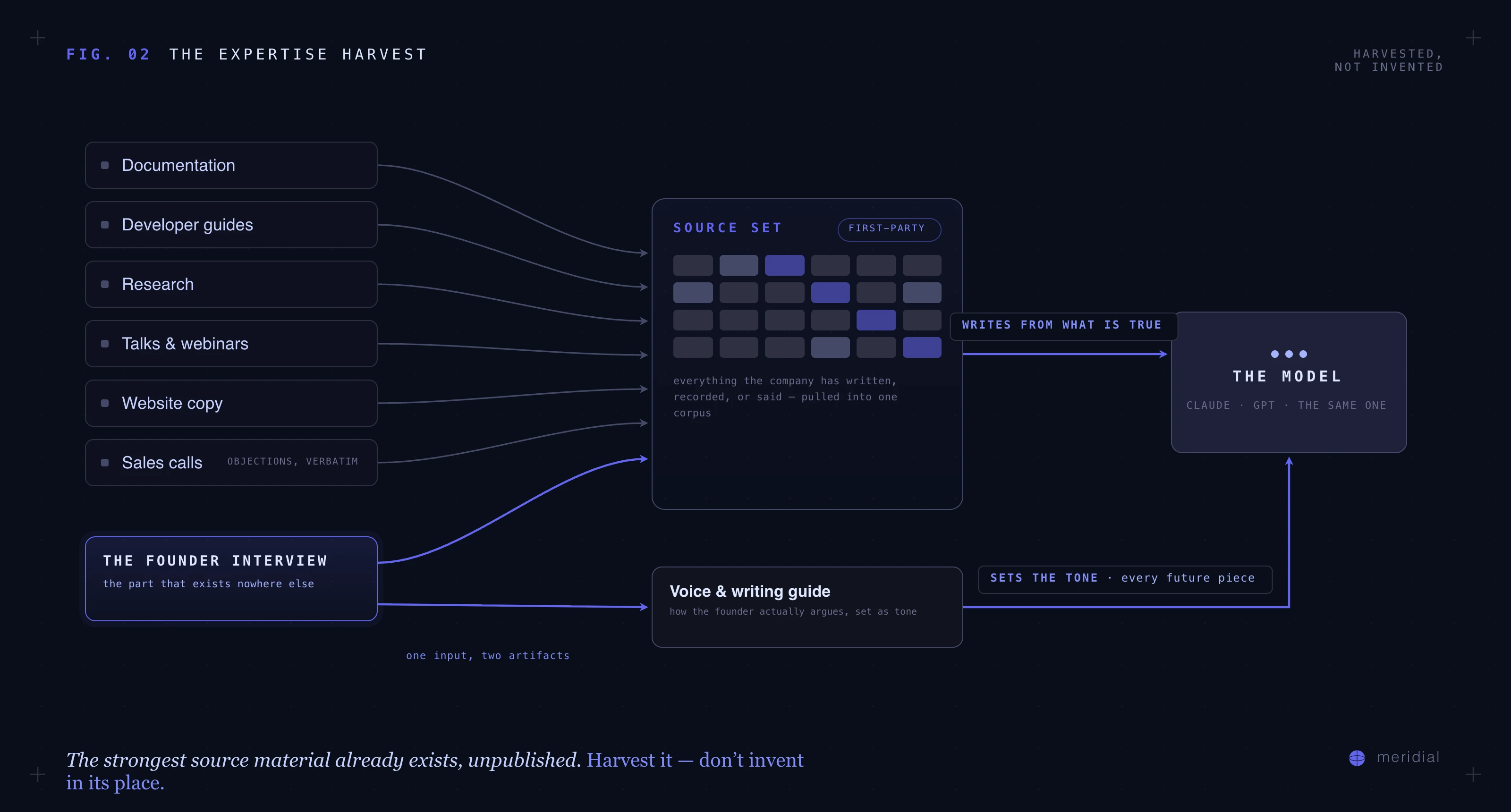
The strongest source material almost always exists already, unpublished. A digital asset company sits on documentation, developer guides, research, recorded talks and webinars, website copy, and, most underused of all, sales calls. Good AI content is built by harvesting all of it, not by inventing in its place.
The thesis is simple: everything the company has ever written, recorded, or said to a prospect is raw material. Sales calls deserve special mention because they hold the buyer's objections in the buyer's own words, which is exactly the language relevant content should answer in. Pull the full corpus into the source set and the model works from what is true and specific instead of filling gaps with plausible filler. The output is authentic because it genuinely is the company's expertise, reorganized and sharpened.
At Meridial we add a layer on top of the harvest that most teams skip: a long founder interview, run as part of every engagement. It captures the material that lives only in someone's head, the thesis, the reasoning behind architectural decisions, what pilots actually taught the team, the contrarian read on where the market goes. No competitor can copy it, because it does not exist anywhere else.
The interview does a second job that is easy to miss. Hearing how the founder actually argues, which analogies they reach for, what they refuse to say, is what calibrates the voice and writing guide itself. The same conversation that produces source-grade content also defines the tone every future piece is written in. One input, two artifacts.
How do you know what your buyers actually need to read?
Relevance starts with knowing exactly who you are talking to. Before any content decision, research the buyer universe properly: who is actually in it, the state of their industry with numbers, the structural forces moving it, where the commercial pressure sits, and what changed in the last twelve months. Do that work and the buyers' real pains fall out of the analysis. Skip it and you are asserting pains you guessed.
That is the general thesis, and it is the difference between content that names a problem the buyer is living this quarter and content that gestures at one. A piece aimed at "crypto companies" lands nowhere. A piece aimed at a mapped segment, written against that segment's actual economics and constraints, reads like it was written for the person holding the budget, because it was.
At Meridial this research is a standing discipline of the intelligence layer, and it produces a dossier per segment before a word of content exists. Each brief maps the segment's scope and boundary, its size and trajectory with sourced numbers, how firms in it actually win business today, the procurement sequence buyers run, the fee economics that say what they can afford, and the pains that fall out of all of the above.
Buying signals sharpen the picture further. We monitor the events that mark a buyer entering the market or a budget opening: new 13F filers disclosing crypto positions, OCC charter applications, fresh MiCA licenses, conference speaker and sponsor lists, companies hiring for crypto commercial roles, governance proposals, funding rounds. Signals do two jobs at once. They time the outreach, and they set the content agenda: a quarter with a wave of MiCA grants is a quarter the licensed universe needs different reading than the one before.
How does the production pipeline hold quality?
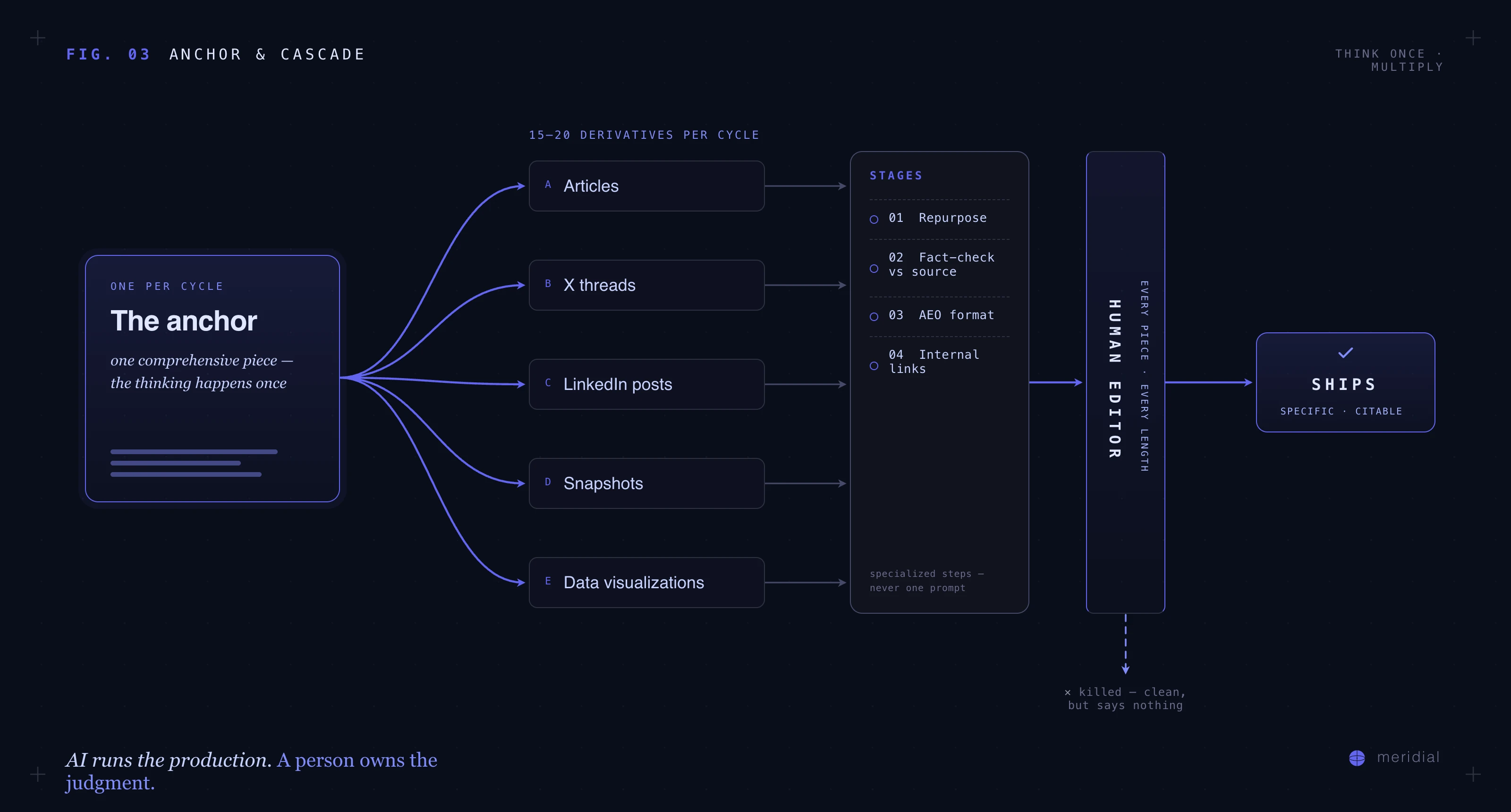
Production runs anchor-and-cascade through a pipeline of specialized agents, never through one overloaded prompt, and a human editor stays in the loop on every piece. One comprehensive anchor is built per cycle, then cascaded into 15 to 20 derivatives: articles, threads, posts, snapshots, visualizations. The thinking happens once. The cascade multiplies it.
Each stage in that pipeline is a skill: a version-controlled procedure an agent loads and executes the same way every run. There is a skill for anchor research, one for each derivative format, one for AEO structure and internal linking, and a fact-check skill that traces every claim to its source and classifies it as faithful and current, faithful but stale, true but unsourced, or invented. The Meridial engine currently runs more than two dozen of them. Because a skill is edited like code, a quality fix made once holds on every piece that follows: in a process, improvements live in someone's head, and in an engine, they compound.
Skills compose into workflows: orchestrated runs that fan one anchor out to parallel agents, each with a single job, on a sequence written as deterministic code rather than left to a model's improvisation. At Meridial, the weekly cascade is a six-agent workflow that turns one anchor into two articles and six short-form posts, each drafted for LinkedIn and X, in a single pass. The most consequential agent in that run writes nothing. Its job is adversarial: attack every claim in every draft before the piece can advance. A writer agent wants its draft to survive, a challenger agent wants the weak number dead, and separating those incentives is a check a do-everything prompt cannot run on itself.
Two more passes do work most teams assume requires a person. One holds every draft against the writing guidelines, and the guidelines are not a generic style sheet: they are extracted from the company's own material and, in our case, calibrated in the interviews we run with the founder and the team, the same conversations described above. An agent checks each draft against that artifact, so the voice that reaches publication is the company's, not the model's default. Another is a humanizing pass that strips the machine patterns readers feel before they can name them: the stock transitions, the overbalanced sentences, the vocabulary no operator uses. Both run before the editor ever opens the draft.
The human editor is the stage we would not remove, and the one we recommend to anyone building a version of this. The architecture makes the gate structural rather than a matter of discipline: no agent in the engine can publish, every skill terminates at a draft in a review queue, and the last permitted action of any agent is to present work for approval. What happens at the gate is what does not automate. An editor kills the piece that is technically clean and says nothing, catches the claim that is plausible but wrong, and keeps the voice from drifting back toward the average. Because the agents have already enforced the guidelines, verified the facts, and stripped the machine patterns, that attention goes to judgment, not proofreading. AI runs the production. A person owns the judgment.
The loop closes after publication. A standing agent reads what each piece earned, the replies, the citations, the answer-engine pickups, and proposes the next cycle's slate from that record, with the editor approving or redirecting. That is the mechanism behind the living context layer described earlier, and the reason month twelve writes better than month one: every piece the engine ships teaches it something.
How does content become pipeline?
Content converts through two paths that run every cycle, and the pairing is the edge. The first is organic plus AEO: every anchor lives on a permanent, structured page and moves through the company's and founder's social accounts. The second is distribution by hand: the same content, put directly in front of the named buyers who need it, at the moment a signal says they are ready.
The AEO path is why structure matters as much as substance. Answer engines cite first-party, well-organized, specific pages, and the Yext study put first-party sites at 44% of 6.8 million citations. A permanent page with clean headings, named entities, and original data becomes the source ChatGPT, Claude, and Perplexity quote when a buyer asks who the credible providers in a category are. That inbound compounds with every piece added to the library, and no competitor can outspend it.
The second path exists because compounding takes time, and Meridial does not wait for it. Organic traction on a genuinely good piece can take months to arrive. So the system also delivers each piece to the relevant people directly: signal-timed outbound that puts the right map or analysis in front of the exact accounts in a buying window, driving awareness and authority with the buyers who matter instead of whoever the feed happens to reach. It changes what outbound is. A message that opens with something the buyer actually needs is useful, not intrusive, and it gets read where a pitch gets deleted. Leading with value is not a tactic bolted on at the end. It is the philosophy the whole system runs on.
What this means
The teams that win attention in digital assets over the next year will not be the ones with a better model. Everyone has the same models. They will be the ones that built the system around the model: a living context layer that encodes who they are and improves with every piece shipped, a habit of mining their own expertise instead of fabricating, intelligence that points the content at real buyers with real pains, a pipeline of specialized agents that holds quality stage by stage, and a human editor who owns the final judgment.
That system is what Meridial builds and operates for digital asset companies, as one of three layers in a go-to-market engine. The intelligence layer maps the buyer universe and reads its signals. Content turns the firm's own expertise into a body of authoritative work. Execution converts both into pipeline: organically, through the company's channels and an AEO presence that answer engines cite, and directly, through signal-timed outbound that leads with value and lands the right piece on the right account at the right moment. If you are building in digital assets and your content reads like everyone else's, that is the conversation worth having.
The conversation worth having
Content that reads like everyone else's is spending your authority.
Meridial builds and operates the system this piece describes, the context layer, the expertise harvest, the buyer intelligence, the agentic pipeline, and the human editorial gate, as one of three layers in a go-to-market engine for digital asset companies.
Common questions
How do you stop AI from producing generic content?
Stop starting from a blank prompt. Build a context layer first, reference artifacts covering the product stack, positioning, voice, buyer cohorts, and the questions buyers ask AI engines, and have the model write against it. Combine that with the company's own source material instead of letting the model invent. Specificity in, specificity out.
What is a content context layer?
A living set of reference artifacts the model writes against before any drafting: the product stack, positioning, a voice guide, buyer cohort profiles, an AI-question map, and any other artifact that adds relevant specificity. It updates continuously, including from content performance data, which is what makes the production engine self-improving rather than static.
Do you still need a human in the loop for AI content?
Yes. A model handles drafting, structure, and volume, but judgment does not automate. A human editor kills pieces that are clean but empty, catches plausible-but-wrong claims, and keeps voice from drifting toward the average. At Meridial an editor reviews every piece before it ships. For optimal output, treat the editor as part of the system, not a fallback.
How do agents keep AI content on brand voice?
The writing guidelines are not a generic style sheet. They are extracted from the company's own material, its published corpus and the interviews run with the founder and team, and encoded as an artifact in the context layer. A dedicated agent checks every draft against that artifact, and a separate humanizing pass strips machine-pattern phrasing before review. A human editor still owns the final call, on judgment rather than on catching voice drift.
Why does AEO matter for a digital asset company's content?
Because buyers increasingly ask Claude, ChatGPT, and Perplexity before they search or take a meeting. Answer engines cite first-party, structured, specific pages: Yext found 44% of citations point to first-party sites. If your content is generic or login-walled, you are invisible at the exact moment a buyer is researching your category.
How does content turn into pipeline rather than just impressions?
Through two paths at once. Organic distribution and an AEO presence earn compounding inbound. And because organic traction can take months, the same content is also delivered directly: signal-timed outbound puts the right piece in front of the named accounts in a buying window. That builds authority with exactly the right buyers and makes outreach useful instead of intrusive, because it leads with value.
Sources
- Originality.AI, "Over Half of Long Posts on LinkedIn Are Likely AI-Generated Since ChatGPT Launched" (2025 study, sample January to November 2025): originality.ai
- Originality.AI, "50%+ of LinkedIn Posts Were Likely AI in 2025, Plus Engagement Insights": originality.ai
- Yext Research, "86% of AI Citations Come from Brand-Managed Sources" (October 2025), analysis of 6.8 million AI citations across ChatGPT, Gemini, and Perplexity: yext.com
- Meridial, "The Meridial System," Content Strategy, and the buyer-universe segment briefs (internal references on the three-layer engine, the context layer, anchor-and-cascade production, and signal monitoring).